Orientation
The short answer
There is no responsible single price for every beginner. A curious first-month learner, a child beginning structured lessons, and an adult returning to piano after ten years need different levels of commitment from the instrument.
The better budget question
How much of the price goes toward key action, stable construction, usable speakers, and a setup that stays ready—and how much goes toward voices or effects you may never use?
What you are buying
What actually drives the price
Key action
Hammer mechanisms and graded resistance cost more to engineer than simple spring-loaded keys. This is the upgrade a piano learner feels at every practice session.
Build & cabinet
A stable stand, integrated pedal unit, solid cabinet, and refined finish add weight, permanence, and cost.
Sound & speakers
Deeper samples, longer decay, stronger amplification, and better speakers can make daily practice more convincing and less tiring.
Brand positioning and included accessories also affect the total. A bench, stand, pedal, and headphones may turn an apparently cheaper instrument into the more expensive complete setup.
Commitment ladder
Three useful buying tiers
Test the habit
Usually lighter, simpler, and highly portable. Useful when commitment is genuinely uncertain, but unweighted action may need replacing once piano technique becomes the goal.
- Lowest financial risk
- Easy to move or store
- Likely future upgrade
The practical sweet spot
Look for 88 touch-sensitive keys with weighted or hammer action, a stable stand, and a usable sustain pedal. This is where technique and value usually meet.
- Realistic daily resistance
- Full-range options
- No premium furniture tax
Buy once, place once
Furniture-style cabinets, integrated three-pedal units, stronger speakers, and more refined actions suit a permanent music space and clear long-term commitment.
- Always ready to play
- Deeper sound system
- Long-term home fit
The other price lever
New vs used
Certainty matters most
You want a warranty, predictable condition, current connectivity, and the option to return an instrument that does not fit the room or learner.
You can test it properly
A well-kept instrument can bring mid-range action and build within a lower outlay—if every key, pedal, speaker, and jack passes an in-person check.
- 01Play every key softly and firmly.
Listen for dead, loud, quiet, or physically uneven notes.
- 02Test the pedal and headphone jacks.
Watch for crackle, intermittent connections, and a pedal that only switches on or off abruptly.
- 03Confirm the full setup.
Include the correct power supply, stand, bench, pedal, and moving cost in the comparison.
Side by side
Tiers at a glance
| Tier | Typical action | Typical setup | Best for |
|---|---|---|---|
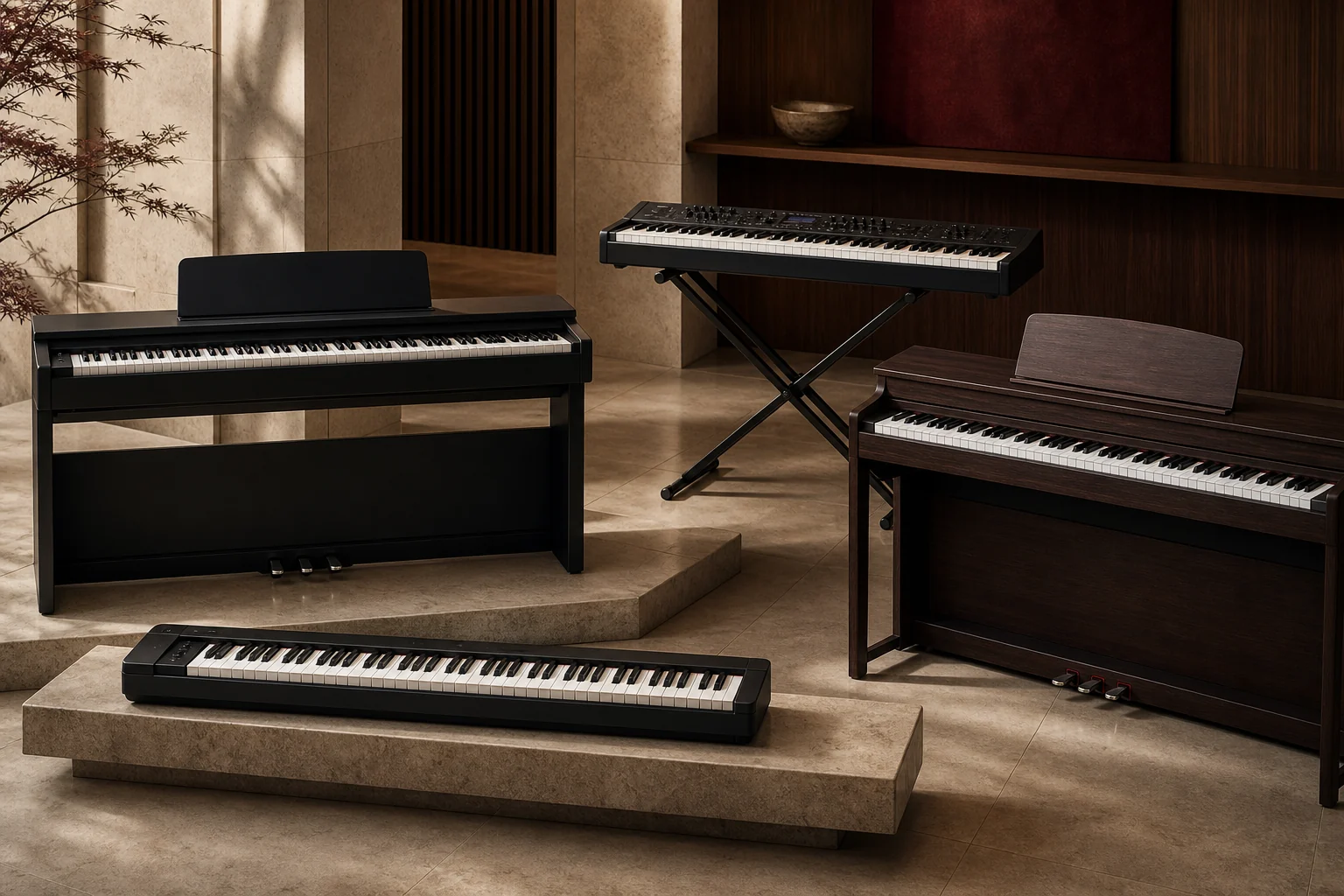
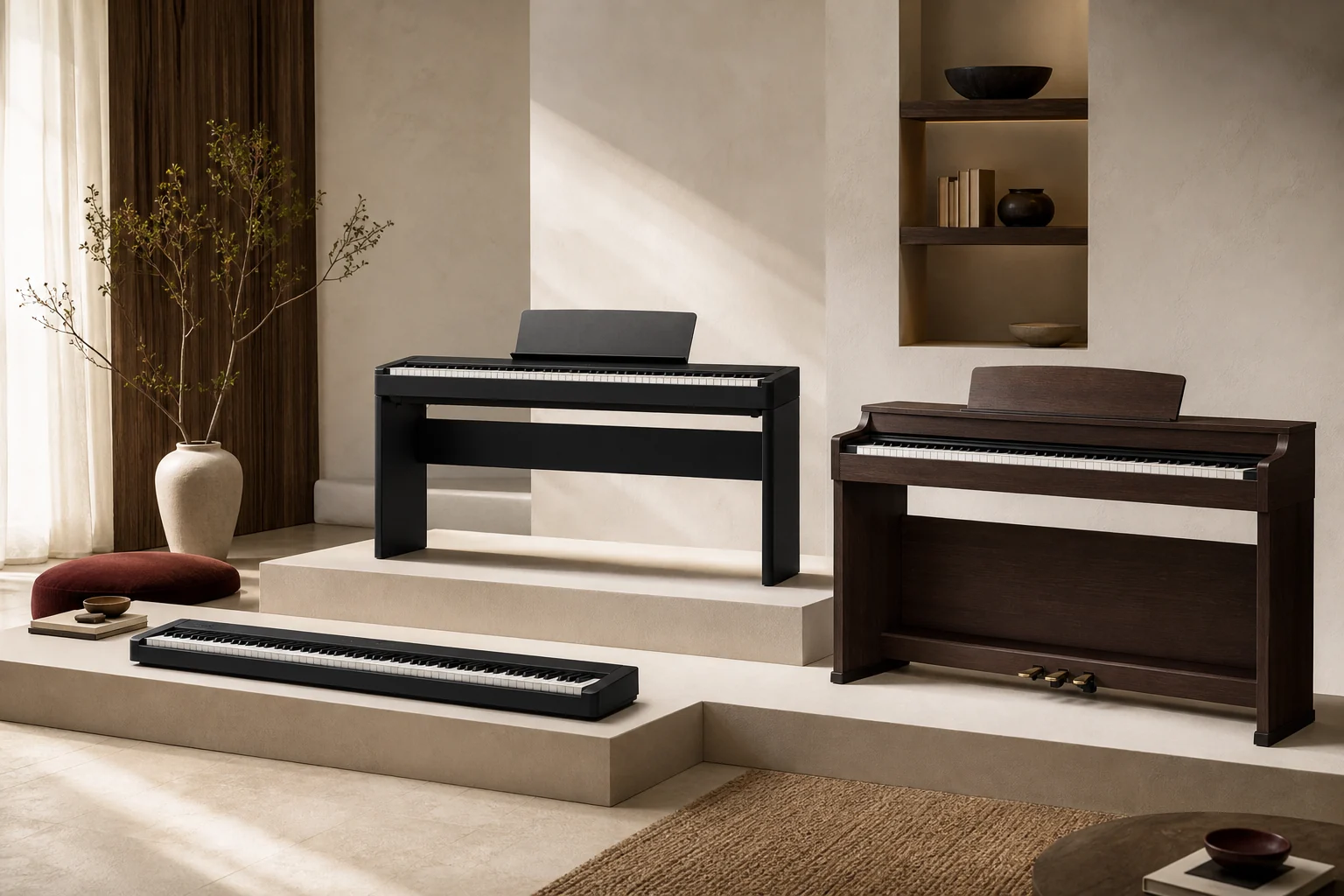
| Entry | Unweighted or light semi-weighted | Portable slab, basic speakers, separate accessories | Testing commitment and high portability needs |
| Mid-range | Weighted or hammer-action options | Stable stand, sustain pedal, improved sound | Most beginners committed to regular lessons |
| Premium home | Refined graded hammer action | Cabinet, triple pedals, deeper speaker system | Permanent setup and long-term study |
Budget discipline
How to avoid overpaying—or underbuying
Do not pay for voices you will not use
An expensive instrument with a light, unweighted action can be a worse piano-learning tool than a simpler model with convincing hammer action.
Decide your current commitment tier first. Inside that tier, prioritize action, stability, and sound at the volume you will actually use. Treat rhythms, hundreds of voices, and novelty lesson features as optional extras.
Editorial note
Verify the instrument in front of you
Prices, bundles, actions, and included accessories vary by model and market. Use this guide as a decision framework, then confirm the current specification and return policy with the manufacturer or seller.
Clear answers
Frequently asked questions
01Is it worth spending more on a first digital piano?
Yes when the extra spend improves key action, stability, speakers, or the complete practice setup. It is less useful when the premium mostly buys more voices, effects, or features unrelated to piano technique.
02What is the biggest factor in a digital piano's price?
Key action is usually one of the biggest differences. A graded hammer mechanism is more complex than a spring-loaded keyboard and has a direct effect on daily touch and technique.
03Should a total beginner buy an expensive instrument right away?
Not automatically. A good mid-range instrument often covers the learning essentials without the cost of a premium cabinet. Spend more when long-term commitment and a permanent home setup are already clear.
04Do built-in pedals matter for beginners?
A dependable sustain pedal matters fairly early. Sostenuto and soft pedals become more relevant later, so an integrated three-pedal unit is desirable but not essential on day one.
05Is buying used a good way to spend less?
It can be. Digital pianos have no strings to tune, and a tested used instrument may offer better action for the same outlay. Check every key, pedal, speaker, jack, and included accessory before buying.